
4 Days in Rome
For first-time visitors and travelers seeking the most highly rated and popular sights
4 Days in Rome
For first-time visitors and travelers seeking the most highly rated and popular sights
Day 1: Ancient Foundations to Baroque Rome
This day traces Rome’s evolution from imperial power to artistic masterpiece, beginning among the ruins of ancient civilization and gradually unfolding into the grand piazzas and fountains that define the city’s modern identity.
Morning
Optional add-on: Visit Basilica di San Clemente, which offers a vertical journey through time, with layers of medieval, early Christian, and Roman structures beneath one another. Requirements for respectful/modest attire apply at churches and other religious sites. Visitors should avoid disrupting religious observances and remain mindful of posted customs.
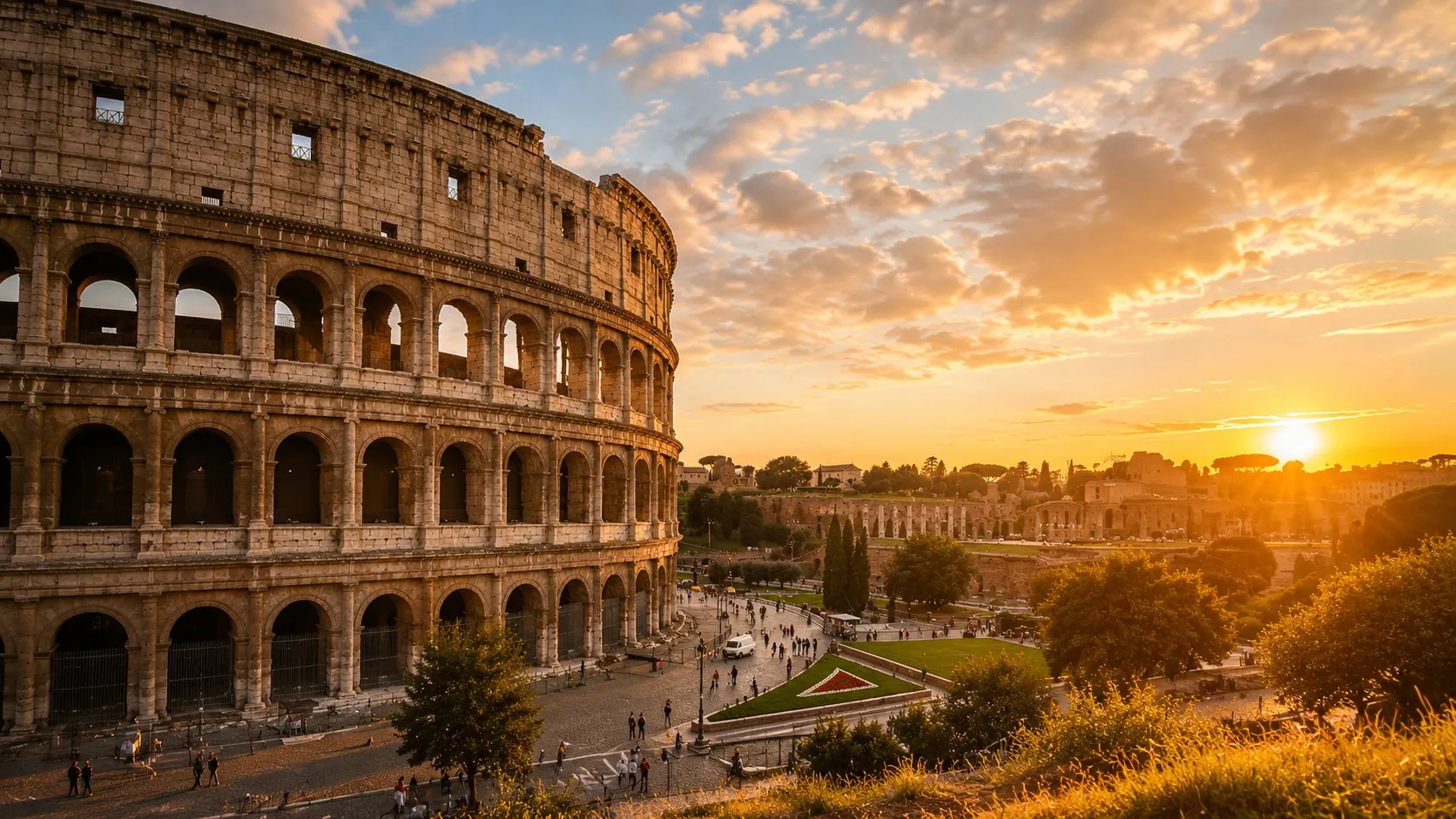
Start your day like a local with a quick espresso standing at the bar of a café. Then head to the Colosseum, the massive amphitheater where gladiatorial games and public spectacles once symbolized imperial power.
Pass by the Arch of Constantine, a triumphal arch commemorating military victory and symbolizing Rome’s transition into the Christian era.
Continue to the Roman Forum and Palatine Hill, the political, religious, and commercial heart of ancient Rome, where temple ruins, basilicas, imperial palaces, and government buildings, tell the story of Rome’s rise.
Afternoon
Have lunch at a neighborhood trattoria, sampling classic Roman pastas: cacio e pepe (pecorino and black pepper), gricia (guanciale, pecorino, black pepper), amatriciana (guanciale, tomato, pecorino), or carbonara (guanciale, pecorino, egg, black pepper).
Make your way to Piazza Navona, a grand Baroque square built atop an ancient stadium, now known for its elegant fountains and vibrant street life. Take a cafe break and do some people-watching.
Continue on to the Pantheon, famed for its perfectly proportioned dome and open oculus.
Evening
Grab a quick snack of supplì (fried rice ball with melted mozzarella at its center) and head to the Trevi Fountain, where legend directs you to toss a coin over your shoulder to ensure a return to Rome. Have dinner in the surrounding streets, where you can try Roman-style pizza, known for its thin, crisp crust.
End the evening at Piazza di Spagna, climbing the Spanish Steps to reach Trinità dei Monti. From the top, take in sweeping views of the city with a gelato to close out the day.
Day 2: Vatican City and Riverside Rome
Discover Rome’s spiritual and artistic center, pairing the grandeur of Vatican City with scenic riverfront landmarks and a more local, lived-in evening atmosphere.
Morning
Pick up a cornetto (Italian croissant) and a cappuccino before heading to Vatican City, starting at St. Peter’s Square, an immense colonnaded plaza designed to embrace visitors arriving at the heart of the Catholic world.
Then visit the Vatican Museums for their extensive art collections, including Renaissance masterpieces and the Sistine Chapel. Note that much of the Vatican Museum is not air conditioned, so plan your visit accordingly. Requirements for respectful/modest attire apply at churches and other religious sites. Visitors should avoid disrupting religious observances and remain mindful of posted customs.
Continue into St. Peter’s Basilica, renowned for its scale, Michelangelo’s dome, and masterpieces like the Pietà.
Stop for a snack of trapizzino (pizza pocket filled with classic Roman stews like chicken cacciatore or meatballs).
Optional add-on: Explore Prati, a neighborhood known for its upscale boutiques, for a local feel away from major tourist crowds.
Afternoon
Explore Castel Sant’Angelo, a fortress originally built as a mausoleum for Emperor Hadrian and later used by popes as a refuge, offering panoramic views from its terrace. Head to Ponte Sant’Angelo, for a photo op at this bridge lined with angel statues leading back toward the historic center.
Evening
Take a sunset cruise along the Tiber River, a relaxed way to see Rome’s landmarks from a different perspective.
Head to Trastevere, where narrow streets and ivy-covered facades create a neighborhood that feels both historic and lived-in. For dinner in the neighborhood, consider Roman favorites of pasta carbonara (eggs, guanciale, and pecorino) for primo and saltimbocca alla Romana (veal with prosciutto and sage) for secondo.
Day 3: Civic Identity and Artistic Mastery
This day explores Rome’s civic and cultural identity, where art, politics, and public space intersect to shape how the city presents itself.
Morning
Begin at Piazza Venezia, a central hub anchored by monumental architecture and modern traffic.
Climb to Piazza del Campidoglio on Capitoline Hill, redesigned by Michelangelo to reflect Renaissance ideals of order and proportion. Visit the collection of Capitoline Museums, which includes the bronze She-Wolf, for insight into how Rome preserves and interprets its past.
Afternoon
Stroll along Via del Corso, a historic thoroughfare blending everyday commerce with architectural continuity, taking a break for a gelato or espresso.
Then browse the Borghese Gallery, where Bernini’s sculptures and Caravaggio’s paintings demonstrate the emotional intensity of Baroque art. The surrounding Villa Borghese gardens provide a green retreat and panoramic viewpoints.
Evening
Stroll through Piazza del Popolo, a grand entrance to the city framed by churches and an ancient obelisk. Consider sampling some classic Roman dishes for dinner, such as saltimbocca alla romana (veal topped with prosciutto and sage) or dishes featuring guanciale, a richly flavored cured pork that is central to Roman cuisine.
Optional add-on: Attend a concert at Accademia Nazionale di Santa Cecilia in the Auditorium Parco della Musica, a modern venue known for its acoustics and contemporary design.
End the evening with rooftop drinks overlooking the city.
Day 4: Markets and Everyday Life
Experience markets, food traditions, and neighborhoods where Rome’s history is embedded in daily routines.
Morning
Begin with a maritozzo, a soft sweet bun filled with whipped cream, or a cornetto, an Italian croissant, and a macchiato at a café near Campo de’Fiori, a historic square that functions as a lively daytime market filled with fresh fruits, vegetables, flowers, and gourmet items.
Participate in an Italian cooking class, where it is common to visit the market to learn about fresh ingredients and to focus on classic Roman pasta dishes such as:
- cacio e pepe (pecorino and pepper)
- gricia (guanciale, pecorino, pepper)
- amatriciana (guanciale, tomato, pecorini)
- carbonara (guanciale, pecorino, egg, black pepper)
Afternoon
Explore Basilica di Santa Maria Maggiore, one of Rome’s major basilicas, known for its stunning mosaics that preserve early Christian artistic traditions. Requirements for respectful/modest attire apply at churches and other religious sites. Visitors should avoid disrupting religious observances and remain mindful of posted customs.
Optional add-on: Visit the Jewish Museum of Rome, to examine artifacts, textiles, and archives documenting thousands of year of Jewish life in Rome, and the attached Great Synagogue of Rome with its distinctive architecture.
Evening
Explore the Ghetto Ebraico di Roma, or the Jewish Quarter, an area shaped by centuries of resilience and cultural continuity. Find a place for dinner and sample one of the neighborhood specialties, carciofi alla giudia (fried artichokes).
Optional add-on: Walk across to Tiber Island via Ponte Fabricio, Rome’s oldest surviving bridge.
End the evening at Gianicolo Hill, which offers one of the city’s most peaceful panoramic views.
Bad Weather Options: Museums
In case of bad weather, visit the:
- Galleria Nazionale d'Arte Antica - Palazzo Barberini to explore a 17th-century palace with an extensive art collection, including works by Caravaggio, Raphael, and Bernini
- National Gallery of Modern and Contemporary Art, which showcases 19th- and 20th-century art, including pieces by Van Gogh, Monet, and Kandinsky
- Galleria Alberto Sordi, a covered shopping gallery with Art Nouveau design
- Galleria Doria Pamphilj to view masterpieces in a historically preserved palace
- Palazzo Altemps, a Renaissance palace filled with ancient sculpture
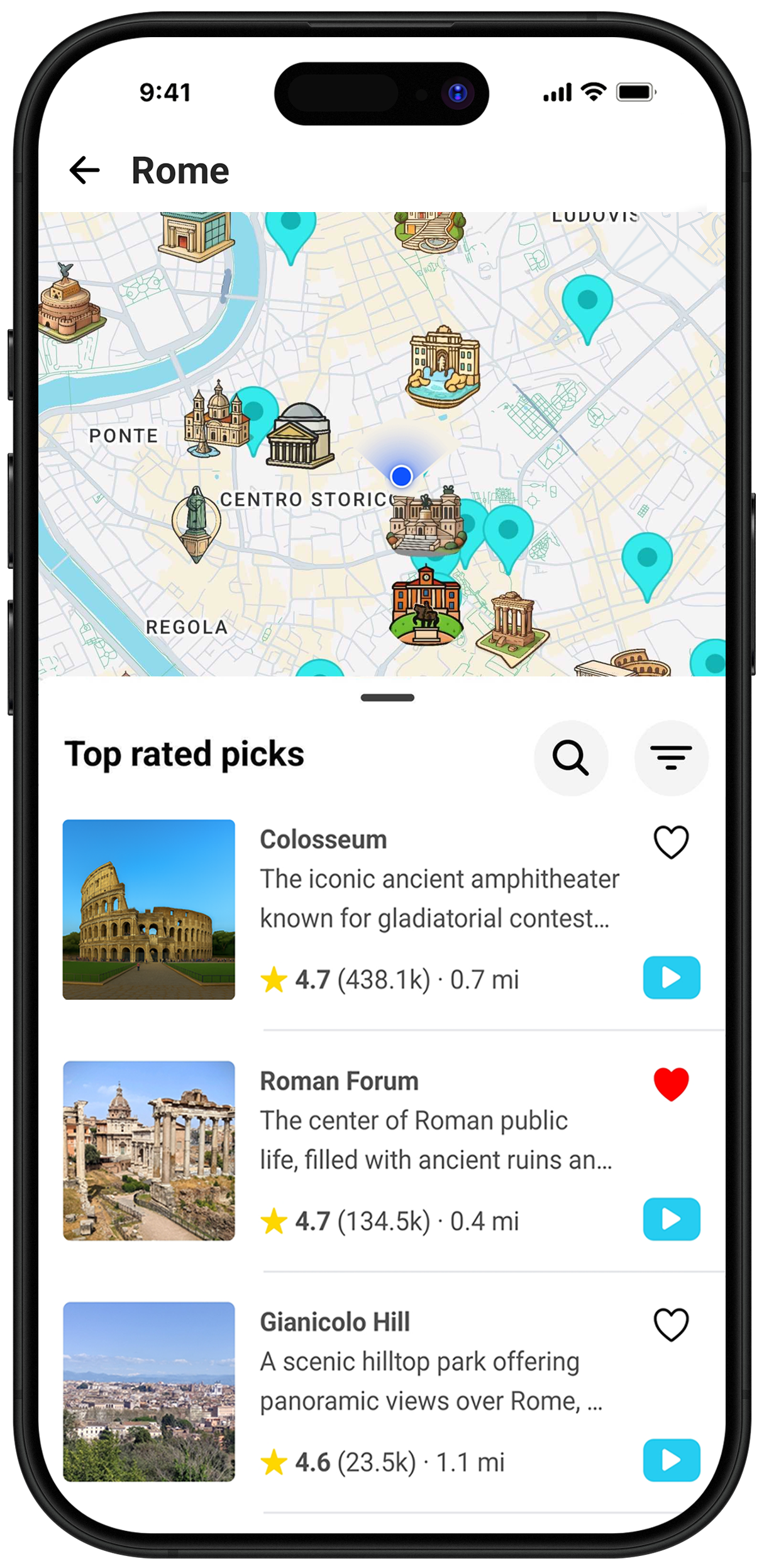
Make the most of your trip with the Travi App
Audio Guides
Professional narrated stories that you can listen to on your own schedule.
Snap & Learn
Point your camera at any monument to instantly identify it and hear its history.
Itineraries
Browse curated day-by-day plans, customize them to fit your style, or build your own from scratch and share with friends.