
5 Days in Mexico City: History and Memory
For travelers seeking an in-depth exploration of the history of the city
5 Days in Mexico City: History and Memory
For travelers seeking an in-depth exploration of the history of the city
Day 1: Ancient Foundations and Colonial Memory
Trace Mexico City's story from the Mexica capital of Tenochtitlan through the Spanish conquest and colonial era, then explore how twentieth-century artists and institutions have interpreted and preserved the country's complicated past.
Morning
Begin in the Zócalo, Mexico City's central plaza and historic heart, where the city's Indigenous, colonial, and modern histories converge.
Continue to the Metropolitan Cathedral, a blend of architectural styles built over several centuries on the site of the former Mexica sacred precinct. Requirements for respectful/modest attire apply at churches, synagogues, and other religious sites. Visitors should avoid disrupting religious observances and remain mindful of posted customs.
Visit the National Palace, where Diego Rivera's murals trace Mexico's history from the Mexica era through the Spanish conquest, colonial period, independence, and Revolution, offering a distinctly Mexican interpretation of the nation's past.
Continue to Templo Mayor, the archaeological remains of Tenochtitlan's ceremonial center, where excavated temples and artifacts reveal the scale and sophistication of the Mexica capital and the transformation that followed the Spanish conquest.
Late Afternoon
Visit the Museo Mural Diego Rivera, dedicated to Rivera's monumental Dream of a Sunday Afternoon in Alameda Central. The mural brings together figures from Mexico's history and offers a concentrated look at how post-Revolutionary artists transformed historical memory into a public narrative.
Stroll through Alameda Central, Mexico City's oldest public park, taking in the historic buildings and monuments surrounding one of the city's oldest civic spaces.
Optional add-on: Continue to the Museo Memoria y Tolerancia, which explores genocide, discrimination, human rights, and collective memory through Mexican and international examples. Use discretion when choosing which exhibits to visit, as some displays may be intense.
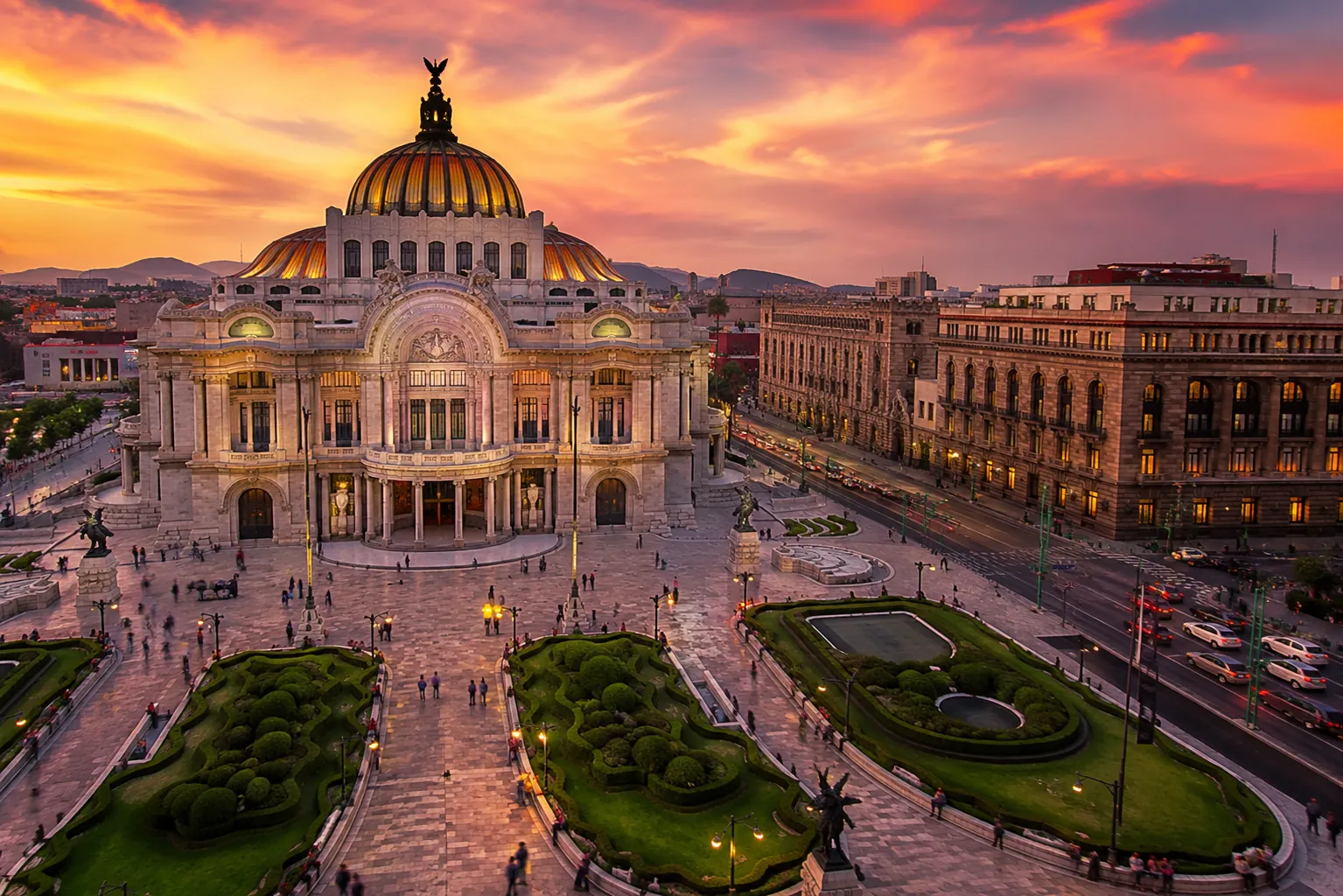
Optional add-on: Visit Palacio de Bellas Artes, one of Mexico City's most recognizable buildings and an important center of Mexican artistic and cultural life. Its murals, architecture, and collections provide another perspective on the cultural nationalism of the post-Revolutionary period.
Evening
Have dinner in the Historic Center of Mexico City, known as the Centro Histórico, where traditional Mexican restaurants and historic cafés provide an atmospheric setting.
Optional add-on: Attend a performance by the Ballet Folklórico de México, if the schedule aligns, for a celebration of regional music, dance, and costume and an exploration of how Mexican cultural identity has been presented through performance.
Day 2: Indigenous Culture and Political Strife
Explore the layered history of Tlatelolco, where an ancient Indigenous city, colonial church, modern housing, and the memory of political violence occupy the same landscape.
Morning
Begin at Plaza de las Tres Culturas in Tlatelolco, where the archaeological remains of the Mexica city of Tlatelolco stand alongside the colonial-era Church of Santiago de Tlatelolco and modern residential architecture. The three distinct layers make the plaza one of Mexico City's most powerful representations of its overlapping histories.
Explore the archaeological site at Tlatelolco, where temples, ceremonial structures, and other remains reveal the importance of this Indigenous city before the Spanish conquest.
Optional add-on: Continue to the Templo de Santiago apóstol, also called the Church of Santiago de Tlatelolco, a colonial landmark built in the aftermath of the conquest and closely connected to the history of Indigenous evangelization. Requirements for respectful/modest attire apply at churches, synagogues, and other religious sites. Visitors should avoid disrupting religious observances and remain mindful of posted customs.
Visit the Memorial 68, which documents the student movement and the October 2, 1968 massacre at Tlatelolco, placing one of the defining moments of modern Mexican political history within the physical landscape where it occurred.
Afternoon
Continue exploring the Tlatelolco area, taking time to consider how the site has been repeatedly reinterpreted, from an important Mexica city to a colonial religious center and, later, a symbol of political repression and demands for democracy.
Evening
Have dinner in Santa María la Ribera, a historic central neighborhood known for being the city's first planned modern neighborhood. Take an evening stroll through the neighborhood, observing the residential architecture and everyday urban life of a part of Mexico City that developed during the city's rapid expansion in the late nineteenth and early twentieth centuries.
Day 3: Independence, Empire, and Revolution
Follow Mexico's transformation from colony to independent republic through monumental symbols, royal and presidential residences, and the places that commemorate the country's revolutionary past.
Morning
Begin along Paseo de la Reforma at The Angel of Independence, Mexico City's iconic monument commemorating Mexican independence. Its prominent position on the city's grand boulevard reflects the importance of independence in Mexico's national identity and the ways successive generations have commemorated the nation's founding.
Continue through Chapultepec Park, one of the city's largest green spaces to Chapultepec Castle, the former imperial residence, presidential palace, and military academy set high above the city. Explore the castle's historic rooms, murals, gardens, and terraces, paying particular attention to the chapters of Mexican history connected to independence, the Reform era, the Second Mexican Empire, and the emergence of the modern republic.
Afternoon
Visit the National Museum of Anthropology, allowing several hours to explore its major collections. Focus on the Mexica, Maya, Teotihuacán, and other Mesoamerican galleries to deepen your understanding of the civilizations that preceded the modern Mexican nation. The museum is also important to the story of memory itself: created in the twentieth century, it presents Indigenous civilizations not simply as ancient history but as a central part of Mexico's national heritage and identity.
Continue to the Monumento to the Revolution, one of Mexico City's most recognizable symbols of the Mexican Revolution.
Visit the National Museum of the Revolution, housed beneath the monument, to explore the political, social, and military upheavals that transformed Mexico in the early twentieth century and shaped the country's modern political identity.
Late Afternoon/Evening
Have dinner in and take an evening stroll through Roma Norte, whose streets and architecture reflect the expansion and modernization of Mexico City during the Porfirian era and the decades surrounding the Revolution.
Optional add-on: If schedules align, experience lucha libre at Arena México, where masked wrestlers, theatrical rivalries, and enthusiastic crowds offer a distinctly modern expression of Mexican popular culture and collective identity.
Day 4: Cultural Icons and Mexican Identity
Explore Coyoacán through the lives and work of Frida Kahlo and Diego Rivera, considering how artists of the post-Revolutionary era drew on Mexico's Indigenous and colonial past to construct a new cultural identity.
Morning
Begin at the Frida Kahlo Museum, housed in the vivid blue former family home where the artist was born, lived, and worked. The collection includes personal belongings, artworks, and rooms preserved to evoke Kahlo's life and creative world. Advance reservations are strongly recommended.
Continue exploring Coyoacán, one of Mexico City's most atmospheric historic neighborhoods. Wander through Jardín Centenario, admire the colonial architecture, and browse cafés, markets, artisan shops, and local food stalls.
Late Afternoon
Visit the Museo Anahuacalli, Diego Rivera's striking volcanic-stone museum designed to house his extensive collection of pre-Hispanic art. The building itself is an architectural attraction, while its collection provides a direct connection between Mexico's ancient artistic traditions and the cultural nationalism of the post-Revolutionary period.
Explore the Museo Casa de León Trotsky, the former home of the Russian revolutionary and political exile, who lived in Mexico City in the later years of his life until his assassination in 1940. The house and museum provide a window into Mexico's role as a refuge for political figures and into the international ideological currents that intersected with post-Revolutionary Mexican politics.
Optional: Visit the National Museum of Interventions, also called the Museo Nacional de las Intervenciones, housed in a former convent, for a deeper look at Mexico's encounters with foreign powers and the wars and interventions that shaped the nineteenth-century republic.
Evening
Have dinner in Coyoacán, where traditional restaurants, cafés, and local food stalls provide many options.
Day 5: Ancient Metropolis and Sacred Memory
Journey beyond Mexico City to one of central Mexico's greatest ancient cities before visiting the an important center of Catholic pilgrimage, connecting pre-Hispanic traditions, colonial encounters, and contemporary Mexican identity.
Day
Take a day trip to the Pyramids of Teotihuacán, the monumental remains of one of ancient Mesoamerica's most important cities. Walk along the Avenue of the Dead and explore the Pyramid of the Sun and Pyramid of the Moon, while learning about the sophisticated civilization that flourished here centuries before the rise of the Aztec Empire.
Optional add-on: Stop at the Basilica of Our Lady of Guadalupe on the return journey to see one of Mexico's most important religious sites and pilgrimage destinations. Explore the modern basilica and the surrounding historic religious complex on Tepeyac Hill, where the tradition of the Virgin of Guadalupe is associated with the Indigenous convert Juan Diego.
Requirements for respectful/modest attire apply at churches, synagogues, and other religious sites. Visitors should avoid disrupting religious observances and remain mindful of posted customs.
Evening
Return to Mexico City for a final dinner in the Historic Center of Mexico City or another neighborhood of your choice, bringing the journey back to the city where the different layers of Mexican history have converged.
Optional add-on: Head to Torre Latinoamericana observation deck for a final panoramic view of Mexico City at night, offering a striking perspective on the modern metropolis built over the successive layers of history explored during the trip.
Bad Weather Options: Museums
In case of bad weather, visit the:
- Museo de la Ciudad de México, which explores the history and evolution of Mexico City through its collections and historic setting
- Museo del Chocolate (MUCHO), which introduces visitors to the history and cultural significance of chocolate in Mexico
- Museo del Estanquillo, which presents the eclectic collection of writer and cultural commentator Carlos Monsiváis and offers a lively perspective on twentieth-century Mexican popular culture and urban life
Optional Trip Extension
To extend your time in Mexico City, consider a day trip to the Historic Centre of Puebla, a UNESCO-listed city where colonial churches, ornate Baroque architecture, tiled façades, and elegant plazas preserve the legacy of New Spain and its transformation of Indigenous and Spanish traditions. Explore Puebla's historic streets and Talavera workshops and then continue to nearby San Pedro Cholula, one of Mexico's oldest continuously inhabited settlements, where the monumental pyramid crowned by a colonial church offers an illustration of the layers of Indigenous and Spanish history.
Make the most of your trip with the Travi App
Audio Guides
Professional narrated stories that you can listen to on your own schedule.
Snap & Learn
Point your camera at any monument to instantly identify it and hear its history.
Itineraries
Browse curated day-by-day plans, customize them to fit your style, or build your own from scratch and share with friends.